GotGame
Using research to reshape participation mechanics in an early-stage competition app.
View Case Study →I centralized sample orders into an existing sales order workflow within a regulated B2B SaaS platform. By unifying the order lifecycle and introducing progressive validations, we reduced clarification cycles between compliance and clients while laying the foundation for scalable automation.
Although users could create regular sales orders directly in the platform, sample orders followed a disconnected, manual process. Clients submitted requests through external forms without visibility into requirements or status, leading to frequent clarifications, rejections, and delays.
Because alcohol regulations vary by state, product type, quantity, and intended purpose, incomplete submissions often require additional back-and-forth before a compliance decision could be made. Internally, compliance and operations teams duplicated effort to review, approve, and recreate orders—introducing operational inefficiencies and legal risk.
Sample Orders outside of client portal
Multiple Source of Truth
Unknown sample order status
Back-and-forth between client and compliance
The platform operates on a shared order model across two environments: a client-facing portal where customers create and track orders, and an internal order management system used by operations and compliance teams.
Although these environments serve different users, they rely on the same underlying order object. Compliance reviews regulatory requirements and intent, while operations handles fulfillment and processing. Each role interacts with the same order at different stages of its lifecycle.
Any change to how sample orders were created or reviewed needed to account for this shared structure and multi-role workflow.
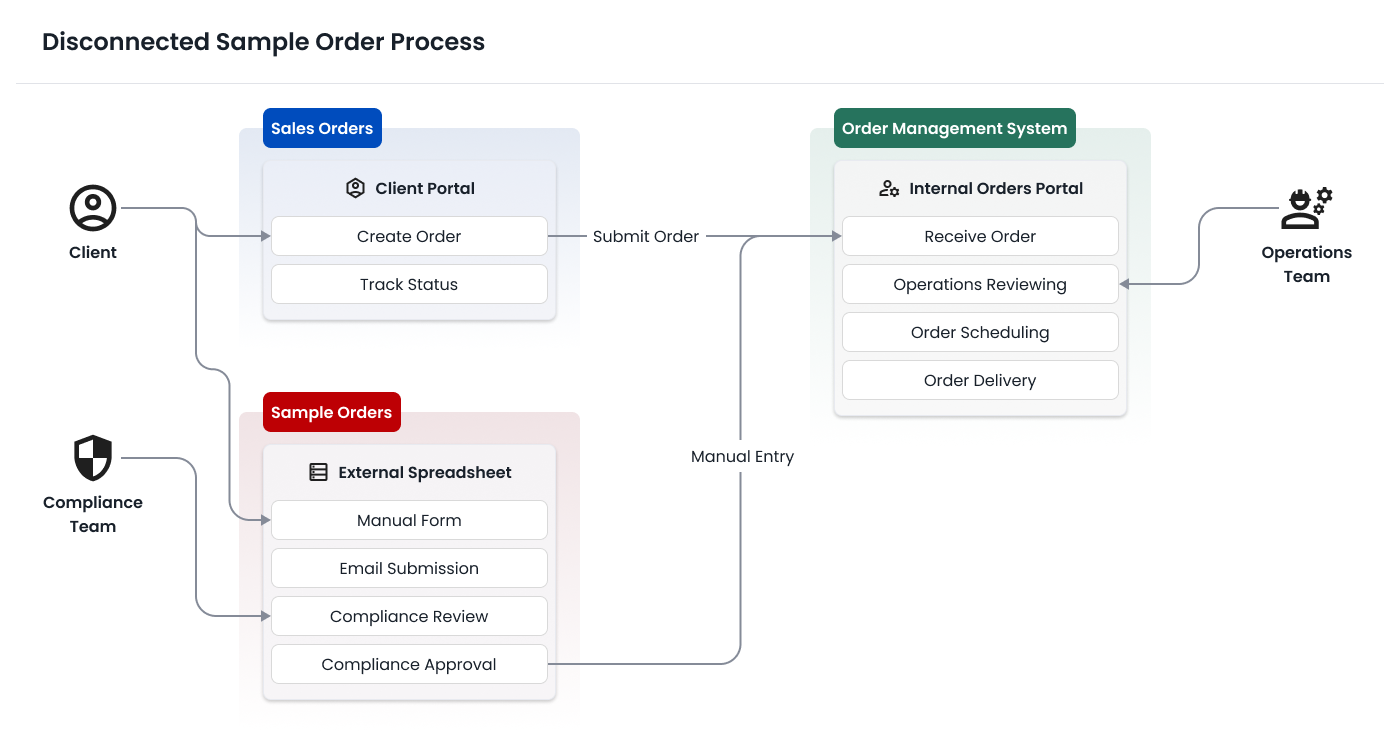
The disconnected sample order process created friction across multiple touchpoints
Early exploration considered creating a separate workflow for managing sample orders. However, because sample orders shared the same underlying data structure as regular sales orders—with the primary differences being a $0 cost and an additional compliance review step—separating them would have introduced fragmentation, duplicated logic, and increased long-term maintenance complexity.
Instead, I proposed centralizing sample orders within the existing sales order lifecycle. By treating them as a variation of the same order object, we preserved a single source of truth while enabling role-specific review states. This approach reduced system sprawl and ensured that all orders—regardless of type—lived within a unified lifecycle.
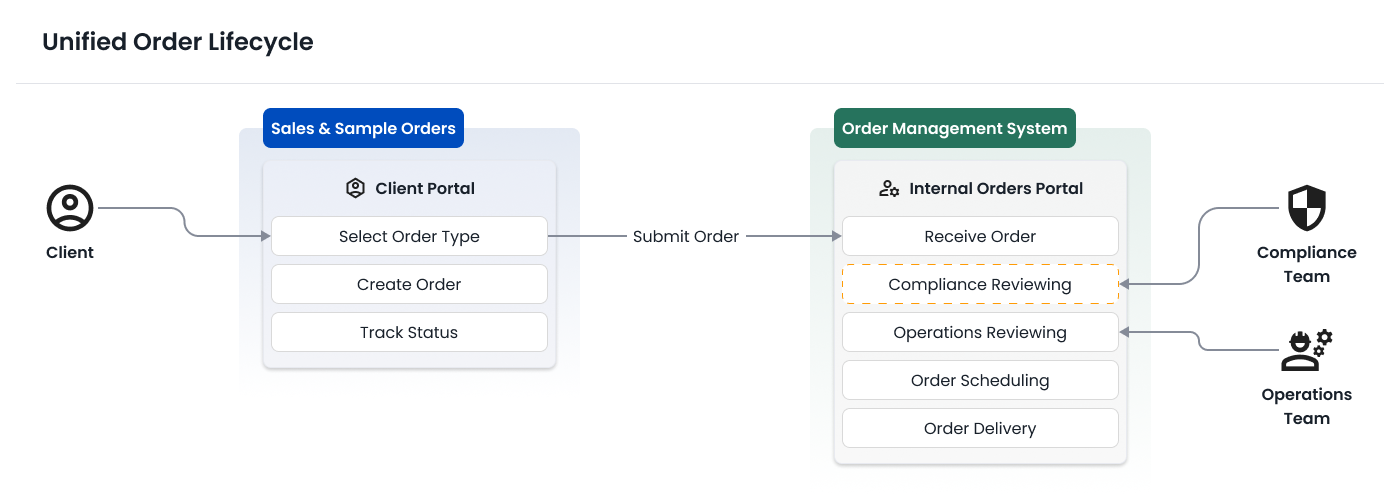
Centralizing sample orders within the existing sales order workflow
While full automation was part of the long-term vision, implementing it in the first iteration would have required encoding highly variable regulatory logic across states, product types, quantities, and intended use cases. Compliance decisions—particularly around the purpose of a sample—often depended on a nuanced interpretation that could not be reliably standardized in v1.
Rather than introducing brittle rules or blocking users prematurely, we adopted a progressive validation strategy. The goal was to reduce avoidable errors while preserving flexibility for human review.
We automated high-confidence checks using existing system data, including:
These surfaced as non-blocking warnings to set expectations before submission, while compliance retained final review authority. This allowed us to ship meaningful improvements quickly and establish a foundation for phased automation.
Progressive validation warnings guide users without blocking submission
Integrating sample orders into the existing order lifecycle required ensuring that compliance teams could quickly identify and review relevant requests without disrupting operational workflows.
Rather than creating a separate review system, I leveraged the existing order management infrastructure and introduced role-focused enhancements, including:
This allowed multiple user roles to act on the same order object within a unified system while maintaining clarity and efficiency.
Role-focused enhancements within the unified order management system
Integrating sample orders into the existing order lifecycle reduced clarification cycles between compliance and clients by surfacing high-confidence validations before submission. Orders reached internal review with clearer information, improving expectation alignment while preserving necessary oversight.
Beyond the immediate operational improvements, this project reinforced the importance of sequencing automation thoughtfully within regulated systems. Not every process should be fully automated in its first iteration. Designing within constraints requires identifying what can be standardized confidently, what requires human judgment, and how to evolve responsibly over time.
This experience strengthened my approach to systems design: prioritize a unified architecture, reduce fragmentation, and move forward pragmatically—even when constraints are present.
Using research to reshape participation mechanics in an early-stage competition app.
View Case Study →Diagnosing conversion barriers in a two-sided remodeling marketplace.
View Case Study →